Break-even ROAS is the return on ad spend at which your ads exactly pay for themselves: below it, every sale loses money; above it, every sale earns some. The formula is short: break-even ROAS = 1 ÷ contribution margin. A product with a 40% contribution margin has a break-even ROAS of 2.5, so every ₹1 of ad spend must bring in at least ₹2.50 of revenue.
Most ad accounts I audit don’t have this number written down anywhere. The ROAS target came from an agency, a benchmark or a guess. This guide shows how to work out your own, with examples in rupees.
Key Takeaways
- Break-even ROAS = 1 ÷ contribution margin (revenue left after product, shipping, payment and return costs, before ads).
- The lower your margin, the higher the ROAS you need just to break even.
- Your ROAS target should sit above break-even, unless repeat purchases justify buying the first order at a loss.
- For B2B lead generation, use the same logic to find your break-even cost per lead.
The break-even ROAS formula
Break-even ROAS = 1 ÷ contribution margin
Contribution margin is the share of each sale left after the costs of making and delivering that sale, before ad spend. Include:
- Product cost (COGS)
- Shipping and packaging
- Payment gateway fees
- Returns, RTO and refunds, as an average per order
- Marketplace or platform commission, if any
Leave out fixed costs like salaries and rent. They matter for overall profit, but they don’t change with each extra order, so they don’t belong in a per-order break-even.
A worked example for a D2C brand
Say you sell a product for ₹2,000 (after GST, more on that below). Per order:
| Cost | Amount |
|---|---|
| Product cost | ₹700 |
| Shipping and packaging | ₹150 |
| Payment gateway fees (about 2%) | ₹40 |
| Returns and RTO allowance | ₹110 |
| Total variable cost | ₹1,000 |
| Contribution before ads | ₹1,000 |
Contribution margin = ₹1,000 ÷ ₹2,000 = 50%.
Break-even ROAS = 1 ÷ 0.50 = 2.0.
So each ₹1 of ad spend must bring in ₹2 of revenue just to break even. In Google Ads terms, that’s a target ROAS of 200%.
How margin changes the number
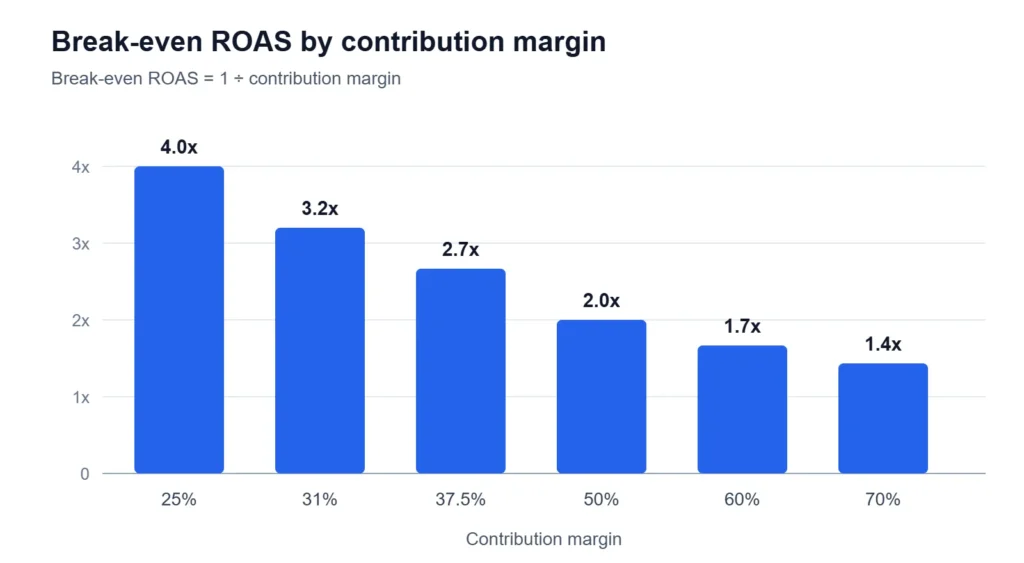
Break-even ROAS rises fast as margin falls. A brand with 25% margins needs twice the ROAS of a brand with 50% margins just to stand still.
| Contribution margin | Break-even ROAS | Google Ads target ROAS |
|---|---|---|
| 25% | 4.0 | 400% |
| 31% | 3.2 | 320% |
| 37.5% | 2.7 | 267% |
| 50% | 2.0 | 200% |
| 60% | 1.7 | 167% |
| 70% | 1.4 | 143% |
This is why two brands can look at the same 3x ROAS and reach opposite conclusions. At a 50% margin, 3x is healthy. At 25%, it’s losing money on every order.
Watch out: is GST inside your conversion value?
In India, the order value your store sends to Google Ads or Meta often includes GST. GST isn’t your revenue, it goes to the government. If your platforms count GST-inclusive revenue but you worked out your margin on the net price, your reported ROAS looks better than it is.
Pick one basis and use it everywhere:
- Best: send the order value without GST and shipping to the ad platforms, and calculate margin on the same net figure.
- If you can’t change the tracking: calculate contribution margin as a share of the GST-inclusive price, so the break-even number matches what the platforms report.
From break-even to a ROAS target
Break-even is the floor, not the goal. Your ROAS target depends on what you want from ads:
- Profit on the first order: set the target above break-even. If you want 15% of revenue left as profit after ads, the ad spend can only use the rest of the margin: 50% − 15% = 35%, so target ROAS = 1 ÷ 0.35 ≈ 2.9.
- Growth through repeat customers: if customers reliably buy again, you can accept a first-order ROAS at or even below break-even and earn the profit on later orders. Only do this if you have real repeat-purchase data, not a hope.
- Blended view: judge new-customer campaigns and retargeting campaigns separately. Retargeting usually shows a higher ROAS because it reaches people who were already likely to buy.
Before raising budgets, it’s usually cheaper to lift ROAS by cleaning up what’s already running. Cutting Google Ads wasted spend and running disciplined Meta ads creative testing both move the number without new spend.
The B2B version: break-even cost per lead
B2B lead generation rarely tracks revenue inside the ad platform, so use cost per lead instead. The logic is the same.
Break-even cost per lead = gross profit per customer × lead-to-customer rate
Example with illustrative numbers:
- A new customer brings ₹3,00,000 of gross profit in the first year.
- 5% of leads from ads become customers.
- Break-even cost per lead = ₹3,00,000 × 0.05 = ₹15,000.
Any channel that brings leads below ₹15,000 each, at the same quality, is profitable on first-year numbers. The catch is lead quality: a cheap lead source that converts at 1% instead of 5% has a break-even cost per lead of only ₹3,000. Track your lead-to-customer rate by channel, not just overall.
Share it with your finance team
Write the calculation down in one place: the cost lines, the margin, the break-even ROAS and the target. When finance asks whether ads are working, you can answer in their terms (contribution margin, profit per order, payback) instead of clicks and impressions.
That’s the approach behind all my client reporting. See how I run all channels as one growth system, or book a free 30-minute audit and we’ll work out your break-even number together.
Frequently Asked Questions
What is a good ROAS?
There’s no universal good ROAS. A good ROAS is one above your break-even ROAS, which depends on your margins. A 2x ROAS is profitable for a brand with 60% margins and loss-making for a brand with 30% margins.
Should I include fixed costs in break-even ROAS?
No. Break-even ROAS is a per-order calculation, so it uses only costs that rise with each order. Cover fixed costs by setting your ROAS target above break-even, so each order leaves money to pay for them.
How is ROAS different from ROI?
ROAS compares revenue with ad spend only. ROI compares profit with total investment. A campaign can have a high ROAS and still a negative ROI if margins are thin, which is exactly why break-even ROAS matters.