Meta ads creative testing is how you find the ads that bring in customers at a cost you can afford, before you put real budget behind them. On Meta today, the creative does much of the targeting: with broad audiences, the ad itself decides who stops scrolling. So a D2C brand that tests creative on a schedule will usually beat one that keeps changing audiences.
This is the system I use. It works with small budgets and doesn’t need a creative team of ten.
Key Takeaways
- Test big ideas (concepts) before small details (button colours, headlines).
- Keep testing separate from scaling, so a test can’t hurt your best ads.
- Give each ad enough spend to judge it: roughly two to three times your target cost per purchase.
- Call a winner on cost per purchase, not on CTR alone.
Why creative matters more than targeting on Meta
A few years ago, detailed interest targeting did most of the work. Now Meta’s delivery system finds buyers on its own, as long as it has good conversion data and an ad that tells it who the product is for. A video of a mother packing a school lunch reaches a different crowd than a slow-motion product shot, even when both run to the same broad audience.
That’s why “our targeting is wrong” is often really “our creative is wrong”.
What to test, in order
Test from the biggest lever to the smallest. Most brands do it the other way round and spend months testing headline wording on an ad whose core idea never worked.
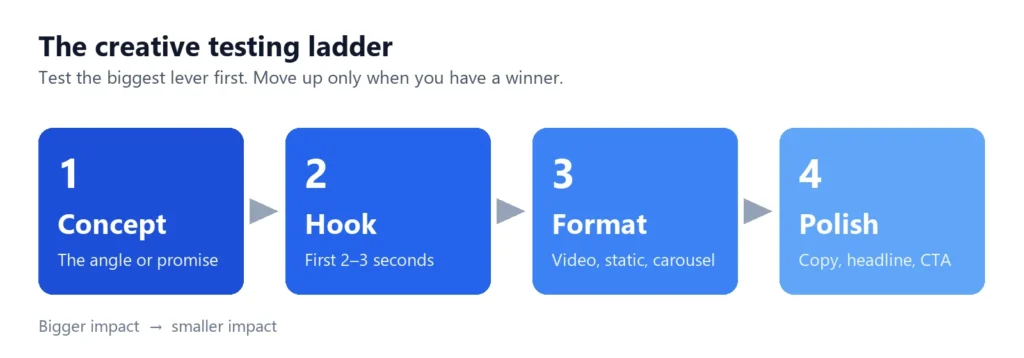
- Concept: the angle or promise. Saves 20 minutes every morning and made for sensitive skin are two concepts for very different buyers.
- Hook: the first two or three seconds of a video, or the main visual and first line of a static ad. Same concept, different way to stop the scroll.
- Format: video, static image, carousel, UGC-style clip, founder talking to camera.
- Polish: primary text, headline, call to action, thumbnail.
Move to the next level only once you have a winner at the current one.
How to set up a creative test
Keep testing and scaling in separate campaigns.
- Testing campaign: one ad set per concept, three to five ads in each, broad audience, the same landing page for every ad. Use a sales objective optimised for purchases if you get enough purchases a week; if not, optimise for add-to-cart until you do.
- Scaling campaign: only proven winners go here. It should get most of your budget.
For a clean head-to-head between two specific ideas, Meta’s built-in A/B test splits the audience so the same person doesn’t see both versions. For everyday testing, the simpler set-up above is enough.
How much budget a creative test needs
A test that stops too early just measures luck. A practical rule of thumb: let each ad spend two to three times your target cost per purchase before you judge it.
Here’s how that works with example numbers. Say your target cost per purchase is ₹500.
- Each ad needs ₹1,000 to ₹1,500 to get a fair read.
- A round of four ads needs ₹4,000 to ₹6,000.
- At ₹1,000 a day on testing, that’s a round every four to six days.
If that’s more than you can spend, test fewer ads per round rather than giving each one less money.
When to call a winner
Look at these numbers in this order:
| Metric | What it tells you | When it matters |
|---|---|---|
| Hook rate (3-second views ÷ impressions) | Does the first moment stop the scroll? | Video ads, early in the test |
| CTR (link click-through rate) | Does the ad make people want to know more? | All ads |
| Cost per add-to-cart | Is the click reaching interested buyers? | When purchases are still few |
| Cost per purchase and ROAS | Does the ad make money? | This one decides |
An ad with a great CTR and a poor cost per purchase is attracting curious people, not buyers. The final check is whether the ad’s ROAS sits above your break-even ROAS. If it doesn’t, it’s not a winner, however good it looks.
Scaling a winner without breaking it
- Move the winning ad into the scaling campaign using its post ID. It keeps the likes and comments it has collected, and that social proof helps it convert.
- Raise budgets in steps. Big jumps send the campaign back into learning.
- Make variations of the winner. A winning concept with three new hooks is your next test round.
How to spot ad fatigue
Every winning ad wears out eventually. Watch for three signs together:
- Frequency rising week after week
- CTR falling
- Cost per purchase climbing while nothing else has changed
When you see all three, the ad is tired. Have the next winner ready from your testing campaign so you can swap it in the same week.
Common mistakes
- Testing five things at once. If the concept, hook and format all change, you don’t know what worked.
- Judging on day one. Delivery is uneven in the first 24–48 hours.
- Letting the testing campaign take over the budget. Testing should be a fixed share, usually 10–20% of spend.
- Ignoring the landing page. If every ad has a good CTR and a poor conversion rate, the problem is after the click.
Need a creative testing system for your brand?
I build and run this exact testing system for D2C and e-commerce brands. See how Meta Ads management works, or book a free 30-minute audit and I’ll review your current creatives.
Frequently Asked Questions
How many creatives should I test at once on Meta?
Three to five ads per concept is a good range for most D2C budgets. Fewer than three gives Meta too little to choose from; more than five spreads the budget so thinly that no ad gets a fair read.
How long should a Meta creative test run?
Until each ad has spent about two to three times your target cost per purchase, and for at least three to four days to smooth out daily swings. With small budgets that can mean a week or more.
Should I use Advantage+ creative enhancements?
Test them like any other variable. Let one ad run with enhancements on and an identical one with them off. Some brands see better results; others find the automatic edits go against their brand style.